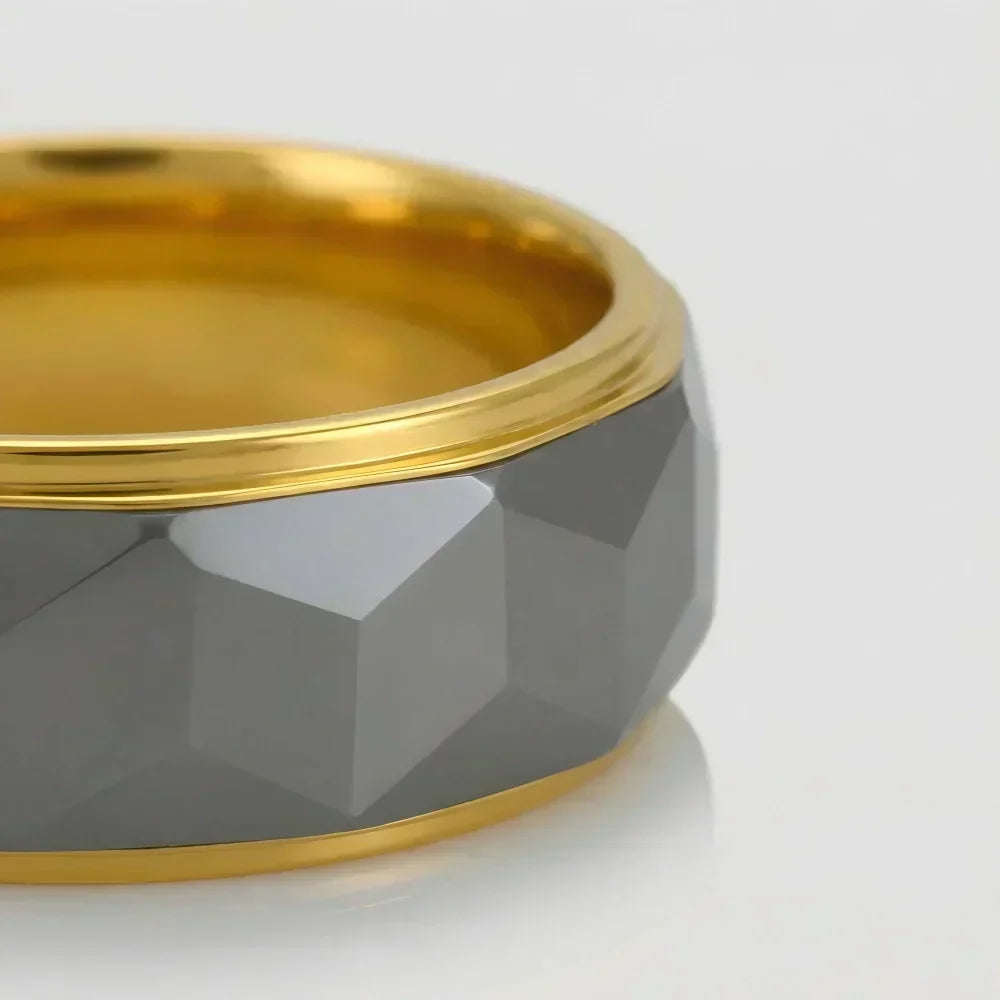
[Archive Entry 019]
The Gravity of Existence: Titanium vs. Tungsten Carbide
Titanium and tungsten carbide get shelved together as "the alternative metals," which hides the fact that they are close to opposites. One was selected by the aerospace industry because it is strong for its weight. The other is used for cutting tools because almost nothing marks it. If you are choosing between them, weight is the decision — everything else follows from it.
Here are the numbers, the trade-offs each material actually forces, and the case for choosing titanium instead.
The short answer
Tungsten carbide is roughly three and a half times denser than titanium and significantly harder. If you want a ring you can feel on your hand all day, tungsten. If you want a ring you forget you are wearing, titanium. Neither is objectively better; they answer different questions.
How they compare
| Property | Tungsten Carbide | Titanium |
|---|---|---|
| Density | 15.6 g/cm³ | ~4.5 g/cm³ |
| Hardness (Mohs) | 9.0 | ~6.0 |
| Scratch resistance | Marked only by diamond and industrial abrasives | Scuffs and scratches with normal wear |
| Can it be refinished? | No — but it rarely needs it | Yes — brushed finishes can be restored |
| Behaviour under a crushing load | Holds geometry, then fractures cleanly | Bends and deforms |
| Emergency removal | Cracked with locking pliers in seconds | Cut with a ring cutter; slower than gold |
| Resizable | No | Very limited; most jewellers decline |
| Skin contact | Stable; reactions trace to cheap cobalt binders | Highly biocompatible; used in surgical implants |
| Electrical conductivity | Conductive | Conductive |
Full parameters are documented on The Standard.
What the weight difference feels like
Density figures are abstract until you hold the object. Our pieces are hand-finished rather than machine-produced in identical runs, so exact weights vary — expect a spread of one to three grams even within the same design and size. As measured examples:
- The Linear Divide, size 12 — approximately 14.3 g
- The Solar Fracture, size 14 — approximately 15.2 g
- The Astral Pathway (18K Gold PVD), size 10 — approximately 8.2 g
A titanium band of the same dimensions would land somewhere near a quarter of those figures. That is the entire argument, in both directions: about four grams sits on the hand as a piece of clothing; about fifteen sits there as an object.
Where titanium is the better choice
We build around density, so it would be easy to pretend otherwise. Three cases where titanium is genuinely the right answer:
- You have never worn a ring and are unsure you will tolerate one. Fifteen grams is noticeable for the first week. Titanium removes that adjustment period entirely.
- You need a ring you can effectively ignore during physical work. Weight registers most when the hand is gripping or overhead.
- You have a documented metal sensitivity. Titanium's implant-grade biocompatibility is well established. That said, if metal in general is the problem, Technical Zirconia removes the variable completely.
The honest cost of choosing titanium is surface life. At Mohs 6 it accumulates visible scuffing from ordinary contact — a steel tool, a granite counter, a car key. It can be refinished, which tungsten cannot, but that means periodically sending it somewhere rather than never thinking about it.
Where tungsten carbide is the better choice
Mohs 9.0 is the practical headline. Five years of manual work leaves a tungsten band essentially as it left the workshop, while a titanium band of the same age reads as visibly used. If the object is meant to be a fixed reference point rather than an accessory in rotation, that permanence is the point.
The second argument is safety, and it runs counter to what most people assume. Tungsten's brittleness is a feature: under a crushing load it fractures and releases the finger rather than flattening around the bone the way a softer metal does. The full mechanism, and the tasks where you should remove any ring regardless of material, are in Archive Entry 011.
Frequently asked questions
Is tungsten or titanium better for a men's wedding band?
Tungsten carbide holds its finish far longer and is substantially heavier; titanium is light enough to forget and can be refinished when it scuffs. Neither can be meaningfully resized, so measure carefully either way.
How much heavier is a tungsten ring than a titanium one?
Roughly three and a half times, by density — 15.6 g/cm³ against approximately 4.5 g/cm³. In a typical 8mm band that is the difference between about four grams and about fifteen.
Does titanium scratch more easily than tungsten?
Yes, considerably. Titanium sits near Mohs 6, so ordinary contact with steel tools, stone surfaces and keys leaves marks. Tungsten carbide at Mohs 9.0 is marked only by diamond and industrial abrasives.
Can either be resized?
Not practically. Tungsten carbide cannot be resized at all, and most jewellers decline titanium beyond a fraction of a size. We handle sizing through Protocol 01 — Complimentary Archive Exchange: one free replacement in the correct size, and you keep the original piece. Measure first using the Structural Band Calibration Guide.
Which is safer in an accident?
Tungsten carbide, in most scenarios. It fractures cleanly under extreme pressure and can be cracked off with locking pliers in seconds; titanium bends and has to be cut. Both conduct electricity, so remove either for live electrical work.
Is titanium hypoallergenic?
Titanium is highly biocompatible and widely used in surgical implants. Tungsten carbide itself is also chemically stable — reported reactions almost always trace to cobalt used as a low-cost sintering binder in cheap rings, not to the tungsten.
The steward's position
Our environment is already weightless. Software, cloud infrastructure and generated content have stripped mass out of most of what a day contains. A ring that feels like nothing simply joins that. Fifteen grams on the hand is a small, constant, physical fact that does not require your attention to remain true.
If that is what you came for, the heaviest profiles sit in FORTITUDE — The Shadow Monolith and The Obelisk are the plainest expressions of it.