[Archive Entry 015]
The Biocompatibility Protocol: Engineering the Biological Boundary
Search for "tungsten ring allergy" and you will find a lot of men who bought a cheap tungsten band, wore it for a few months, and ended up with an itching red line around the finger. That reaction is real. What is usually wrong is the diagnosis — the tungsten is almost never the problem.
The problem is what was used to hold the tungsten together.
Why cheap tungsten rings cause reactions
Tungsten carbide is not cast like gold. It is a powder, sintered under extreme heat and pressure with a binding agent that fuses the carbide grains into a solid. The binder is a small percentage of the finished ring, and it determines almost everything about how that ring behaves against skin.
- Cobalt binder. Widely used at the low end because it is cheap and lowers the sintering temperature. Cobalt is reactive to sweat. Over weeks it oxidises, the band develops a dull grey film, it can leave marks on the skin, and it triggers contact dermatitis in people sensitive to it. This is the source of most "tungsten allergy" reports.
- Nickel binder. Less common in rings but still present in some imported stock. Nickel is the single most common contact allergen in jewellery — roughly one in ten people react to it.
If a tungsten ring tarnishes, that is diagnostic. Tungsten carbide itself does not tarnish. A film forming on the surface means the binder is oxidising.
What actually sits against your skin
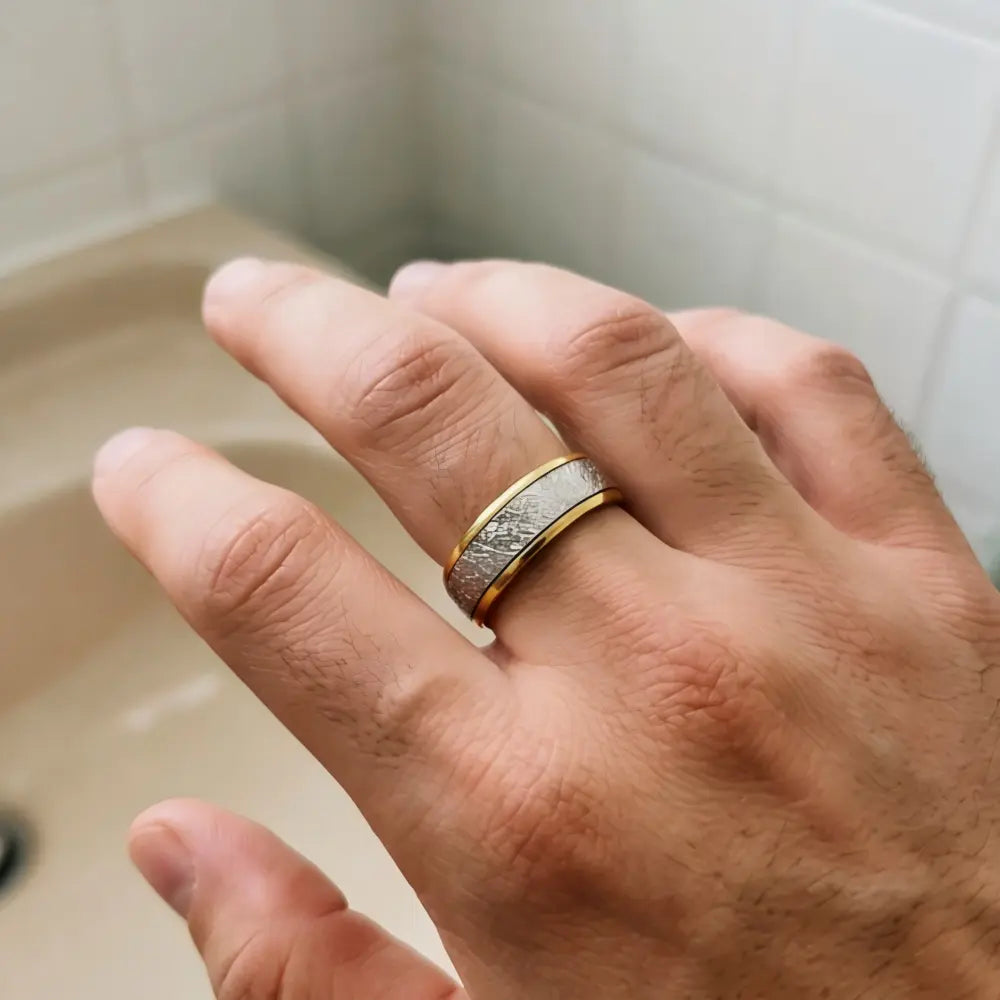
On an Aura Brilliant band there are two surfaces in contact with the finger, and both are chemically stable in normal wear:
- The tungsten carbide substrate. Aerospace-grade, Mohs 9.0, 15.6 g/cm³. Inert — it does not oxidise and does not react with sweat.
- The 18K gold surface, where a piece has one. Applied as a Vacuum Ion-Deposition Interface (industry term: PVD, Physical Vapor Deposition), where gold is vaporised and fused to the core matrix at a molecular level inside a vacuum chamber. It is a bonded surface layer — not a solid gold liner, and not a conventional electroplate that flakes and exposes the substrate underneath.
We are deliberately precise about that last point. The gold is a deposited interface, not a sleeve. Full technical detail is on the Material Science FAQ.
The option that removes the metal question entirely
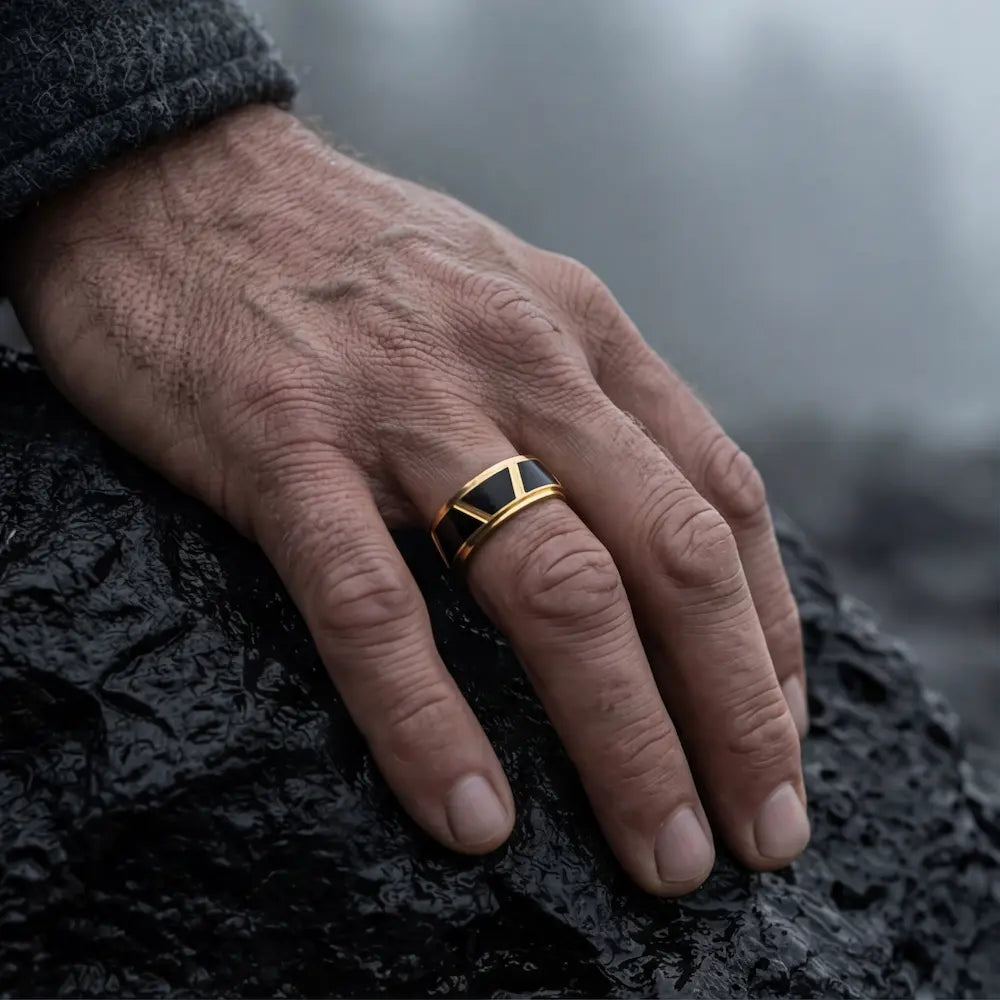
If you have reacted to metal jewellery before — any metal, including gold — there is a cleaner answer than hoping a different alloy behaves. High-Performance Technical Zirconia is a technical ceramic: non-metallic, non-conductive, and fully hypoallergenic by composition rather than by grade.
| Tungsten Carbide | Technical Zirconia | |
|---|---|---|
| Density | 15.6 g/cm³ | 6.0 g/cm³ |
| Hardness (Mohs) | 9.0 | 8.5+ |
| Metal content | Metal carbide | None |
| Electrical conductivity | Conductive | Non-conductive |
| Allergen risk | Determined by binder quality | No metallic allergens present |
| Trade-off | — | Roughly 60% lighter; less of the anchoring mass |
The honest trade is weight. Zirconia gives up most of the density that the rest of this archive is built around. If the mass is what you came for, that matters; if your skin has ruled out metal, it is not a compromise at all. The Obsidian Prism is the ceramic piece in the current range.
Frequently asked questions
Are tungsten rings hypoallergenic?
Tungsten carbide itself is inert and does not react with skin. Whether a specific ring is hypoallergenic depends on the binder used to sinter it — cobalt and nickel binders are what cause reactions at the low end of the market. If you have a known metal sensitivity, Technical Zirconia removes the variable completely.
Why did my tungsten ring turn my finger green or grey?
Tungsten carbide does not oxidise, so discolouration points at the binder. A grey or dull film on the band, or a mark on the skin, usually indicates cobalt reacting with sweat.
Can I wear a PVD gold ring if I am allergic to gold plating?
Reactions attributed to "gold plating" are usually to the base metal exposed as a thin electroplate wears through, or to nickel used in the plating stack. A Vacuum Ion-Deposition surface behaves differently because the gold is molecularly bonded rather than deposited as a removable layer. If your sensitivity is severe or undiagnosed, ceramic is the safer starting point.
Can I shower or swim wearing it?
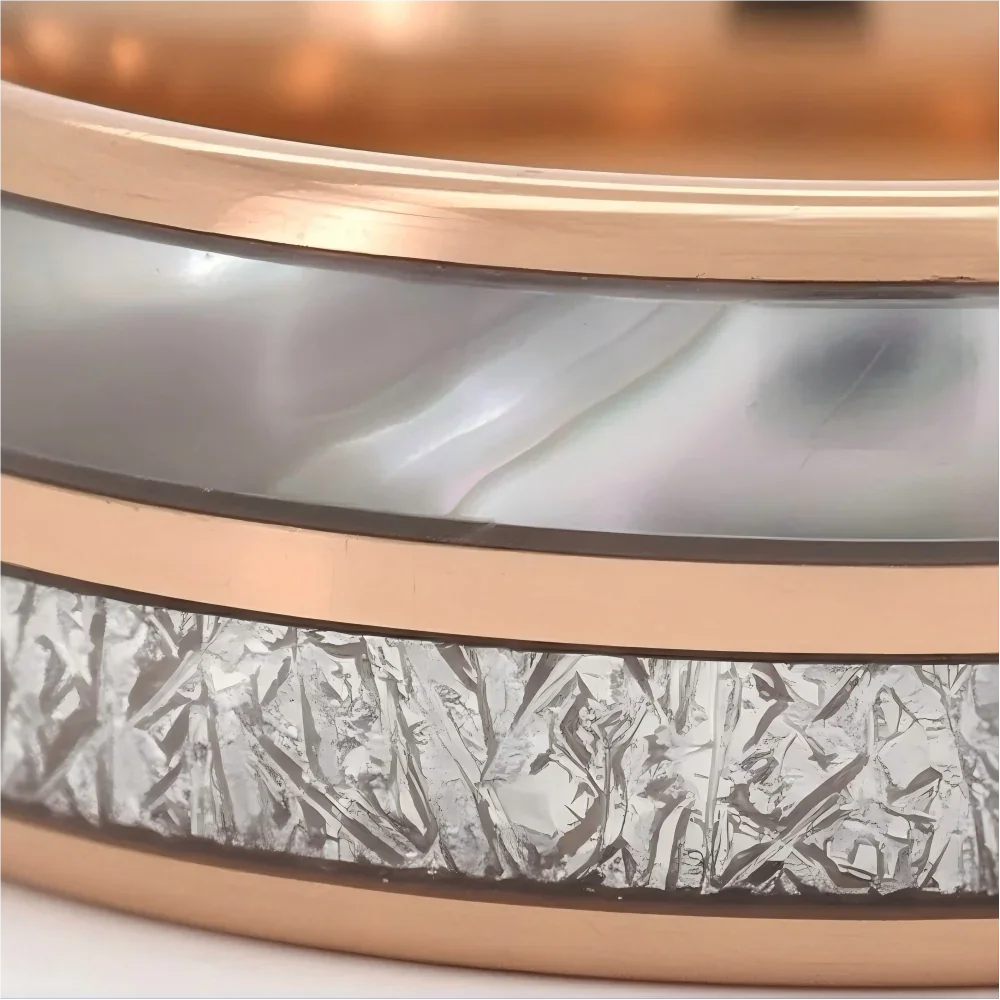
Yes. Neither tungsten carbide nor the deposited gold surface is affected by water. Inlays — meteorite, timber, opal, malachite — are vacuum-sealed within a clear-coat matrix and are also water resistant. Avoid prolonged exposure to chlorine and industrial cleaning chemicals, which attack the sealant rather than the metal.
What if the ring still irritates my skin?
Trapped moisture and soap residue underneath a band cause irritation independently of the material — it is common with any wide, close-fitting ring. Remove it, dry the finger, and clean the inside of the band before assuming a material reaction. If it persists, our Returns & Resilience Protocol covers the 14-day window.
The steward's position
A physical anchor should be something you stop noticing except for its weight. No itching, no film building on the inside of the band, no reason to take it off at the end of the day. That absence is the objective. Browse the full range in FORTITUDE and EQUILIBRIUM, or start with the ceramic option if metal has been a problem before.