[Archive Entry 010]
Why Forged Damascus Steel and Tungsten are the Definitive Wedding Bands for Engineers
If your working life is defined by load-bearing capacities, material tolerances and fatigue limits, there is something incongruous about marking a lifetime commitment with a metal chosen for its resale value and its ease of being melted down.
Traditional wedding bands are made from gold and silver because those metals were historically stores of wealth and because they were easy for a jeweller to work. Neither reason has anything to do with whether the object survives contact with your hands. For a technical mind, that is the wrong specification.
What goes wrong with a soft-metal band
Look at a 20-year-old gold wedding band under any light. The circle is no longer circular. The surface has accumulated a dense field of scratches that read as a dull haze rather than individual marks. If it had any surface treatment, that is long gone.
This is not neglect — it is the material behaving as specified. 18K gold sits around Mohs 2.5–4.0. Most things you touch daily are harder than that: a steel tool, a granite worktop, a car key, sand. Every contact removes a small amount of material, permanently.
The material specification that actually fits
Our Damascus pieces use a bipartite architecture, and it is worth being precise about which part does what.
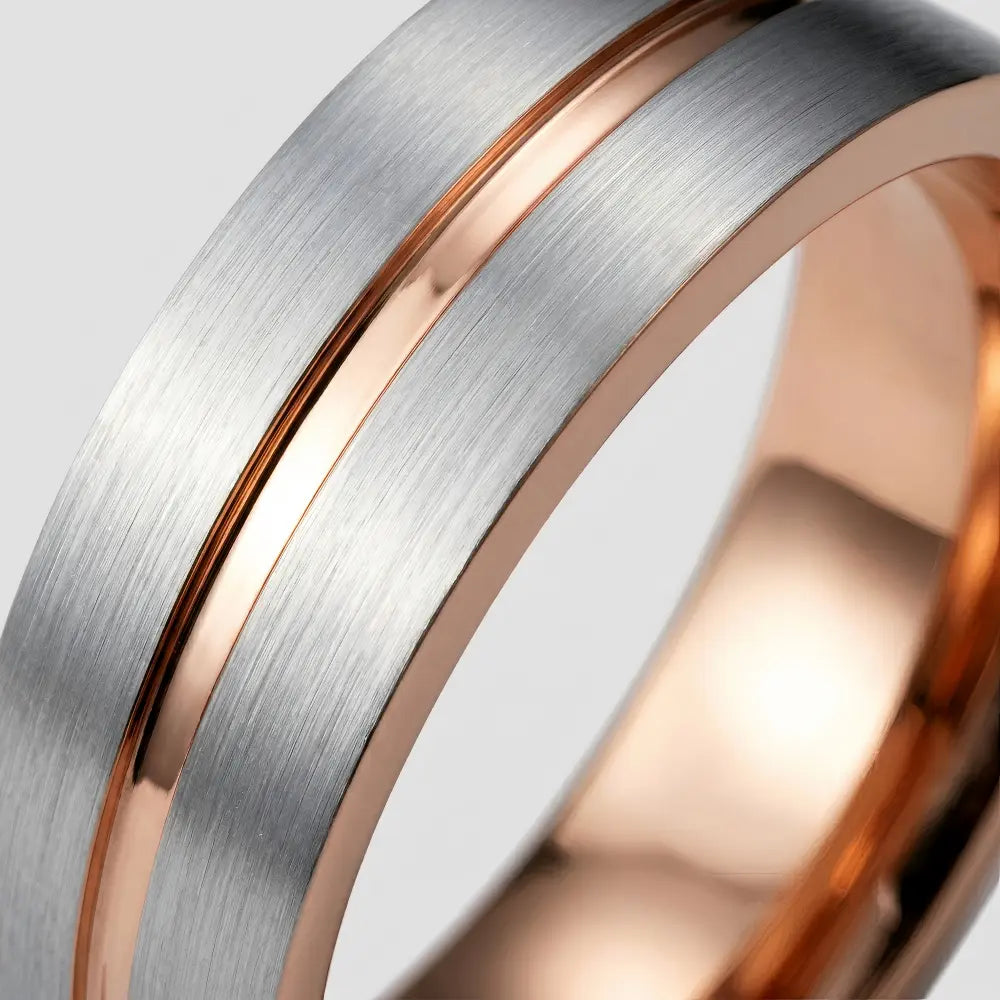
- The tungsten carbide chassis. 15.6 g/cm³ density, Mohs 9.0 hardness. It provides the mass and the scratch resistance. It does not deform under kinetic stress; when it exceeds its limit it fractures rather than bends, which is also what makes it safer than gold under a crushing load — see Archive Entry 011.
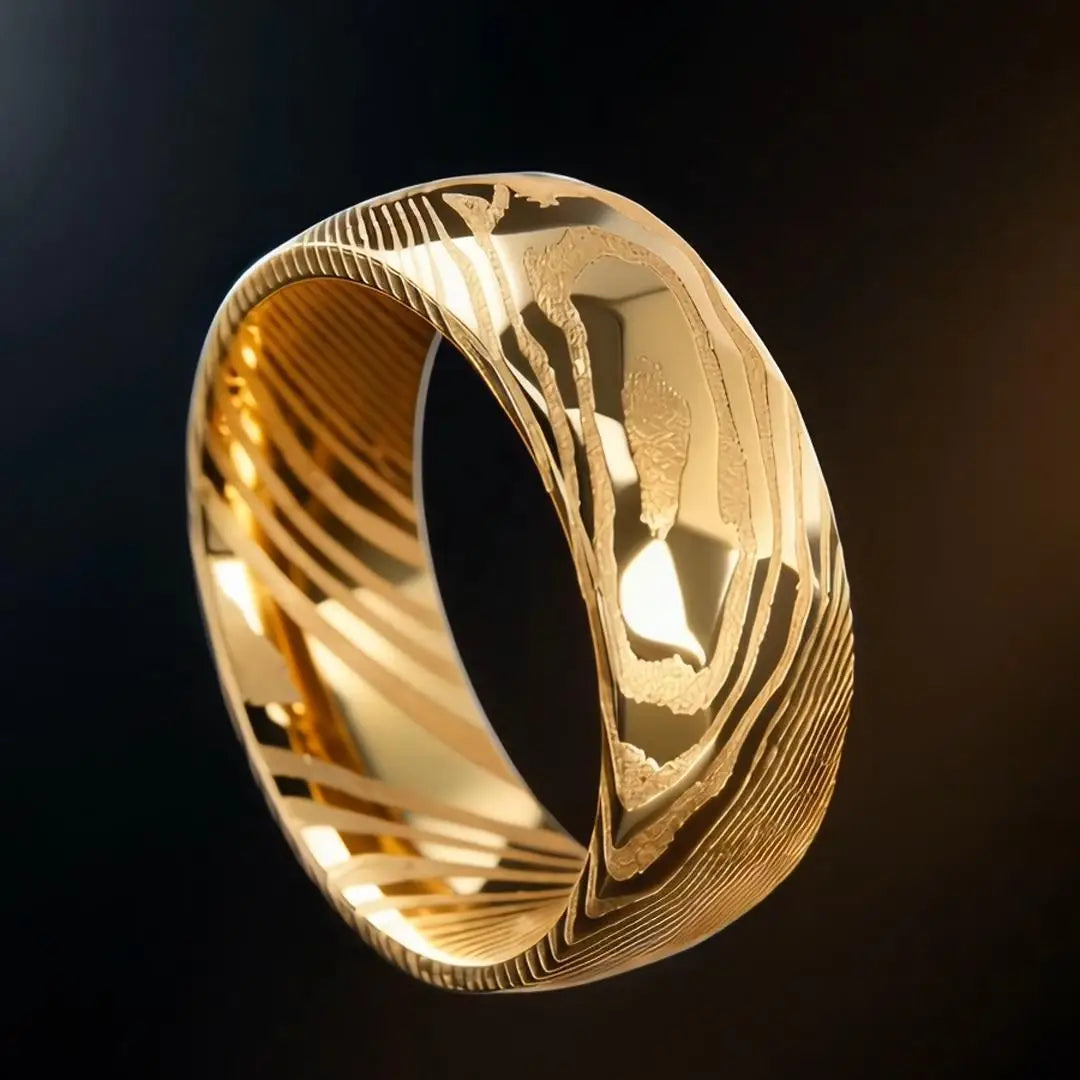
- Forged Damascus steel (Causal Stratigraphy). The visible striations are not a printed or laser-etched surface pattern. The billet is hand-forged and folded repeatedly, then deep acid-etched to expose the internal layer boundaries. The pattern runs through the entire matrix, which is why it cannot be replicated by surface treatment — and why no two bands read identically.
- The 18K gold, where a piece has it. Applied as a Vacuum Ion-Deposition Interface (industry term: PVD). Gold is vaporised in a vacuum chamber and fused to the core matrix at a molecular level. It is a bonded surface layer, not a solid gold sleeve and not a conventional electroplate that flakes off at the edges.
How the materials compare
| Property | Tungsten Carbide | 18K Gold | Titanium |
|---|---|---|---|
| Density | 15.6 g/cm³ | 15.5–15.9 g/cm³ | ~4.5 g/cm³ |
| Hardness (Mohs) | 9.0 | 2.5–4.0 | 6.0 |
| Scratch accumulation | Negligible in daily wear | Visible within months of manual work | Moderate |
| Deformation under load | None — fractures instead | Bends and flattens | Bends |
| Resizable | No | Yes | Limited |
Full parameters are documented on The Standard.
The trade-off worth understanding before you buy
Permanence cuts both ways. Because tungsten carbide cannot be resized, the sizing decision is made once. We handle that with Protocol 01 — Complimentary Archive Exchange: one free replacement in the correct size, shipped at no cost, and you keep the original. But the practical implication stands — measure carefully, and note that a wide band reads tighter than a narrow one at the same nominal size. Archive Entry 016 covers the method.
Frequently asked questions
Is Damascus steel suitable for a wedding ring?
Yes, with one caveat. Forged Damascus is a layered steel and, in raw form, some patterns can develop surface oxidation over years. On our pieces the tungsten carbide chassis carries the structural load and the Damascus is the surface architecture. Long-term finish evolution is addressed under Protocol 04, which covers professional resurfacing.
Will a tungsten wedding band scratch?
Effectively no, in normal use. At Mohs 9.0 the practical exceptions are diamond and industrial abrasives. This is the single most visible difference from gold after five years of hands-on work.
Can matching bands be made in different sizes and widths?
Sizing and available widths are listed on each product page. Because a wider profile requires a larger size, a matching pair does not necessarily mean identical size numbers.
Is a PVD gold band the same as gold plated?
No, and we are careful not to overclaim in the other direction either. It is a deposited surface layer, not solid gold. The distinction from conventional electroplating is that the gold is molecularly bonded in a vacuum rather than deposited in a chemical bath, which makes it substantially harder and more wear-resistant. Details on the Material Science FAQ.
Can it be engraved?
Yes — a Causal Inscription can be added at checkout. Note that inscribed pieces are permanently locked and final sale, and the 14-day window and size exchange no longer apply. Confirm your size first.
The steward's position
A commitment does not need to be symbolised by something soft. If the specification matters to you, the Damascus work sits in DAMASCUS STRUCTURE — The Meridian Fold at an 8mm calibrated profile, or The Bedrock Crucible with a vacuum-sealed gold channel through the core.